Acts Journey · Acts 27
Acts 27 · Two Exhibits · The Ship's Log
The Voyage
The courtrooms are over. Now there is only weather — and a promise that has to survive it.
Acts Journey · Acts 27
Acts 27 · Two Exhibits · The Ship's Log
The courtrooms are over. Now there is only weather — and a promise that has to survive it.
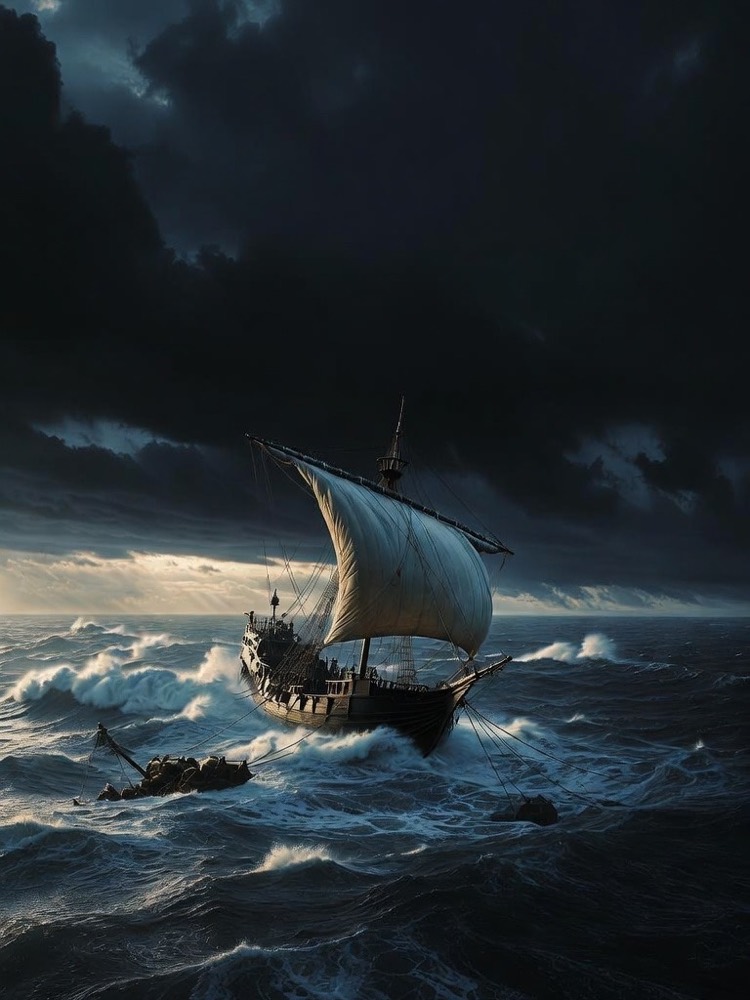
For six Sundays the drama was forensic — charges, hearings, verdicts, a man defending himself with words. From Acts 27:1 it turns physical: wind, rope, water, hunger. Paul finally sails for Rome, and it nearly kills him. No judges, no speeches — just a storm, and 276 people who have no idea that the prisoner in their hold is the reason they are going to live. The "we" narrative, silent since 21:18, picks up at 27:1 and never stops: everything here is Luke as eyewitness, the most detailed sea voyage surviving from the ancient world.
And the controlling image is not "the storms in your life" — Luke is writing a log, not a metaphor. It is a company. Nobody on that ship chose anybody else on it: a centurion and his soldiers, a ship's captain, an owner with grain in the hold, professional sailors, a group of condemned prisoners, a Macedonian, a doctor, and an apostle in chains. A motley crew assembled by a court order and a cargo manifest — and God put every one of them there on purpose. Only one man aboard knows why the ship is really afloat. And he is the one in chains.
"You will all die unless the sailors stay aboard."
That is the rule of the whole chapter (v.31). God had already promised that not one life would be lost — and the way he keeps it is: nobody gets off. The sailors were the most capable people on board, and their competence was about to kill everyone — so the soldiers cut the lifeboat away and let it drift. A quiet exit strategy isn't caution; on this ship it's the one thing that drowns everybody. The vessel itself goes down (v.22) while every soul lives — the thing that carries them is broken in the carrying. The company is not saved because the ship was strong. It is saved because of who was aboard.
Two exhibits · Acts 27
Beneath the surface — rank, skill, capital and a majority vote, all against one prisoner. A soft south wind that only confirmed the decision they'd already made — and everything trusted goes over the side in order of value.
Beneath the surface — a ship coming apart, 276 who haven't eaten, and a prisoner who takes bread, gives thanks out loud, and breaks it — the Last Supper verbs, on a sinking ship. And everyone takes heart.
Some swam. Some held on to planks and broken pieces of the ship. No two of them came ashore the same way — but every single one came ashore, exactly as promised, and every one of them got wet. Vessels and seasons and structures all come apart eventually. The people God binds together come ashore. That's the truer picture anyway — and the one edge a storm teaches that calmer rooms can't: here, the most capable people were the ones most able to leave. Staying was the gift.
Nobody chose this crew. Nobody could leave it. And every single one of them came ashore.